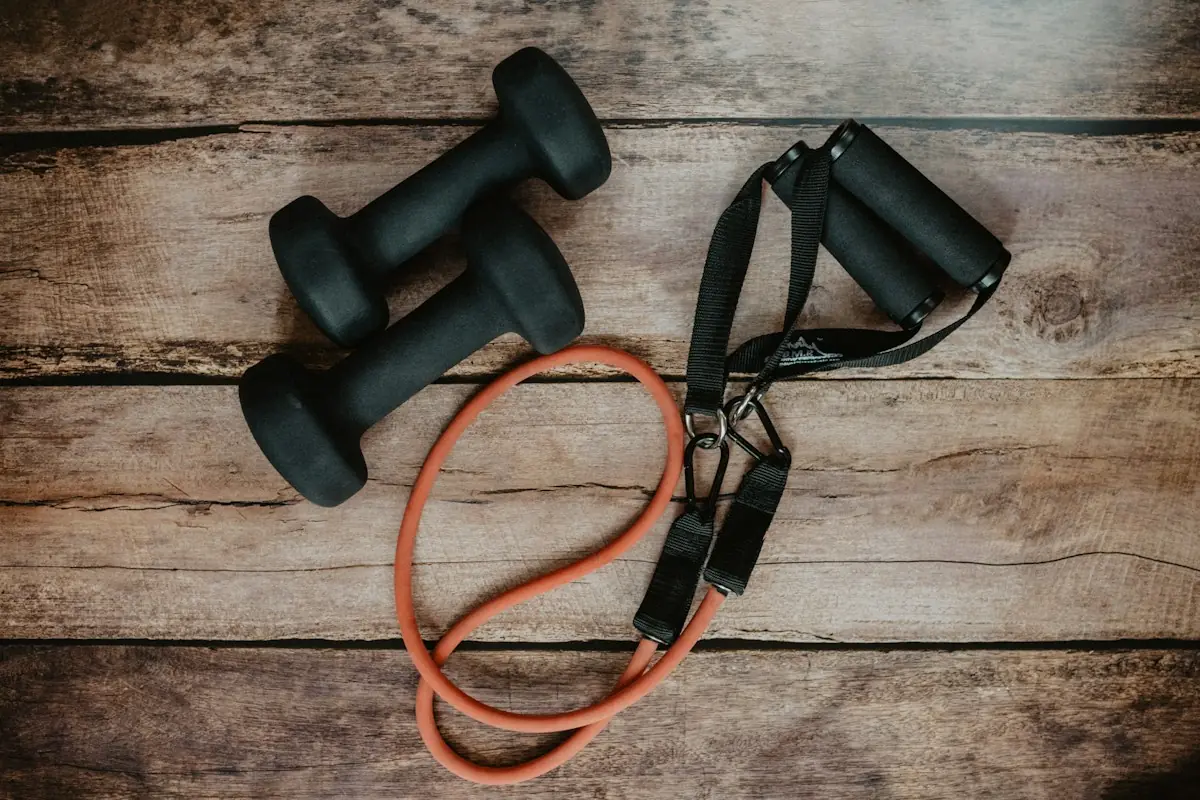
Why lift while losing weight
When you eat less, your body can lose muscle along with fat. Strength training gives it a reason to keep muscle, so more of what you lose is fat. The CDC recommends muscle-strengthening activity at least 2 days a week for adults.
The good news for beginners: 2 or 3 short full-body sessions a week, built on 5 basic moves, is enough to start. You don't need a gym.
Five moves that cover everything
| Pattern | Start with | Progress to |
|---|---|---|
| Squat | Sit-to-stand from a chair | Goblet squat with a dumbbell |
| Hinge | Glute bridge | Dumbbell Romanian deadlift |
| Push | Wall or counter push-up | Floor push-up or dumbbell press |
| Pull | Band row | Dumbbell row |
| Carry | Walk holding grocery bags | Heavier dumbbell carries |
Explainer · 0:22
Read the transcript
- Not all the weight you lose is fat. In trial body scans, roughly a quarter to two-fifths of weight lost on GLP-1s was lean mass.
- Eating enough protein and doing strength training both help protect that muscle while the weight comes off.
- A common target while losing weight is 1.2 to 1.6 grams of protein per kilogram a day. At 180 lb that's about 98 to 131 grams.
- Split it across meals. About 30 to 45 grams at each of three meals is far easier than catching up at night.
A simple weekly plan
Do all five moves, 2 or 3 sets of 8 to 12 reps, 2 or 3 days a week with a rest day between. Stop each set with 1 or 2 reps left in the tank. When you can do 12 reps easily, add a little weight or a harder version.
Fuel and recover
Eat enough protein, found with the protein calculator, and sleep 7 or more hours. Mild soreness for a day or two is normal; sharp pain isn't.
A 30-minute beginner session
- Warm up: 5 minutes of brisk walking and arm circles
- Goblet squat or chair sit-to-stand: 3 sets of 10
- Push-up (wall, counter or floor): 3 sets of 8 to 12
- Dumbbell or band row: 3 sets of 10 per side
- Glute bridge: 3 sets of 12
- Farmer's carry: 3 walks of 30 to 40 steps
Rest about 60 to 90 seconds between sets.
Form tips that prevent injuries
- Move slowly and with control, especially on the way down
- Keep your back neutral; don't round it to lift
- Breathe out during the hardest part of each rep
- Stop if you feel sharp pain, and ask a trainer or physical therapist for help
What the research says
- Keeping muscle while dieting: Trials comparing diet alone with diet plus strength training generally find less lean mass loss when people lift. The evidence is fairly strong.
- Older adults: In a 2017 NEJM trial of adults 65 and older with obesity, diet plus combined aerobic and strength training improved physical function the most, and that group lost less muscle and bone than the aerobic-only group.
- Calories burned: Lifting burns modest calories, and claims of a big metabolism boost afterward are overstated.
Your first 8 weeks
| Weeks | Plan |
|---|---|
| 1 to 2 | 2 sessions a week, 2 sets of each move, focus on form |
| 3 to 4 | 2 or 3 sessions, 3 sets of each move |
| 5 to 6 | Add a little weight or a harder version to 1 or 2 moves |
| 7 to 8 | 3 sessions a week; keep adding reps or weight when 12 reps feel easy |
Write down what you lift. Seeing the numbers creep up is a great motivator, and the one-rep max calculator can help you track strength over time.
Simple gear for home
- A sturdy chair or bench
- A set of resistance bands
- 1 or 2 pairs of dumbbells, or an adjustable set
- A mat for floor work
No gear yet? Water jugs, a backpack with books and a step all work to start.
Common beginner mistakes
- Going too heavy too soon, before the form is solid
- Training the same muscles hard on back-to-back days
- Skipping the warm-up
- Quitting after a sore first week; soreness fades as your body adapts
Pair your lifting with enough protein and a modest deficit, as in body recomposition.
Fitting strength around cardio
You don't have to choose. Lifting and walking on the same day is fine, and many people lift first, then walk. If you also run or cycle hard, leave a few hours or a day between hard cardio and leg-focused lifting so both feel good.
Short on time? A 20-minute strength session plus a 20-minute walk covers both in under an hour. For the bigger picture, read the best exercise for weight loss.
On a GLP-1 medicine
Strength training is one of the best ways to limit muscle loss during fast weight loss. See exercise on a GLP-1. Check with your clinician before starting if you have heart, joint or blood pressure concerns.
Run your numbers
Keep reading

Common questions
How often should beginners lift weights?
Two or three full-body sessions a week, with a rest day between, is plenty to start.
Can I strength train at home?
Yes. Body-weight moves, a pair of dumbbells or resistance bands are enough for months of progress.
Will lifting make me bulky?
Unlikely, especially while eating in a calorie deficit. Most people look leaner and firmer.